



If your operations, finance, or sales team has been running commissions on Qobra and you are starting to feel the edges — reporting that won’t bend the way you need, data that lags behind the pipeline, or plans that get harder to maintain as complexity grows — you are not alone. A growing number of organizations are weighing Qobra alternatives in 2026, driven by the need for deeper reporting and control, real AI capabilities, and a platform that scales with them.
This guide walks through the 10 best alternatives to Qobra, explains why teams decide to switch, and gives you a framework for choosing the platform that fits your organization. Whether you are in operations building plans, in finance reconciling payouts, or in sales leadership looking for transparency that motivates reps, this article is structured to help you make an informed decision. We cover each platform’s positioning, strengths, and ideal use case — starting with Remuner, the highest-rated platform on this list — followed by a feature comparison table, a migration checklist, and answers to the questions teams ask most when switching.
Why teams look for a Qobra alternative
1. The mobile experience trails the desktop version. This is the single most consistent complaint. Reviewers repeatedly say Qobra’s mobile experience isn’t as smooth as its polished desktop interface, and many want a dedicated mobile app to check commissions on the go. For reps who spend their day out of the office, it’s a recurring ask that Qobra hasn’t fully answered.
2. Occasional delays in data updates. Some users report that new deals or data can take time to appear in Qobra, which undercuts the real-time visibility reps rely on. Many note this partly traces back to their own CRM or ops data flows — so results depend on upstream data quality — but the lag shows up often enough in reviews to be worth flagging when you evaluate how fresh your commission numbers need to be.
3. Limited customization and filtering. Reviewers ask for more control over dashboards, reporting visuals, and filtering. A common example is the deal list, which becomes hard to navigate once you have 100+ closed-won deals — with requests for filters by rep name or deal name to find a specific record quickly. RevOps and finance teams, who need reporting to bend to their questions, tend to feel this ceiling first.
4. A learning curve as plans grow complex. Several reviewers note that initial setup requires careful data alignment, and that the platform’s depth means it takes time to learn all its configuration options. The more complex the compensation plan, the more involved that early setup becomes — and a few reviewers also flag occasional calculation issues to reconcile along the way. Teams scaling into sophisticated, multi-tier plans want that depth without the friction.
What Qobra’s own G2 reviews say. On the upside, reviewers most often praise ease of use (206 mentions), an intuitive interface (72), simplicity (67), real-time tracking (61), and clarity (59).
On the downside, the most-cited themes are time delays (17), limited customization (14), a learning curve (14), poor mobile experience (13), and calculation issues (13). The pattern is clear: reps love the day-to-day experience, while the friction concentrates in mobile, reporting flexibility, and complex-plan setup.
What to prioritize in a Qobra replacement
When evaluating alternatives, focus on the criteria that address what is actually pushing you to switch:
- Customizable reporting and filtering: Can each team shape its own dashboards and filter large deal lists to find a record fast — the flexibility Qobra reviewers most often want?
- A real mobile experience: Is there a dedicated mobile app reps will actually use to check earnings on the go?
- Real-time data sync: Does the platform sync natively and in real time with your CRM (HubSpot, Salesforce, Pipedrive), ERP, and HRIS, so numbers don’t lag the pipeline?
- AI that reduces work: Does the platform use AI to build plans, answer rep questions, and coach sellers toward higher earnings, or is “AI” just reporting?
- No-code plan building: Can your ops team create, modify, and test any plan — simple or complex — without code or external consultants?
- Total cost of ownership: Look past the license fee to implementation, plan-change costs, and support tiers — these often cost more than the license itself.
- Audit and compliance controls: Can finance trace every calculation back to the source deal and plan rule, with ASC 606 support where needed?
The 10 best Qobra alternatives in 2026
1. Remuner
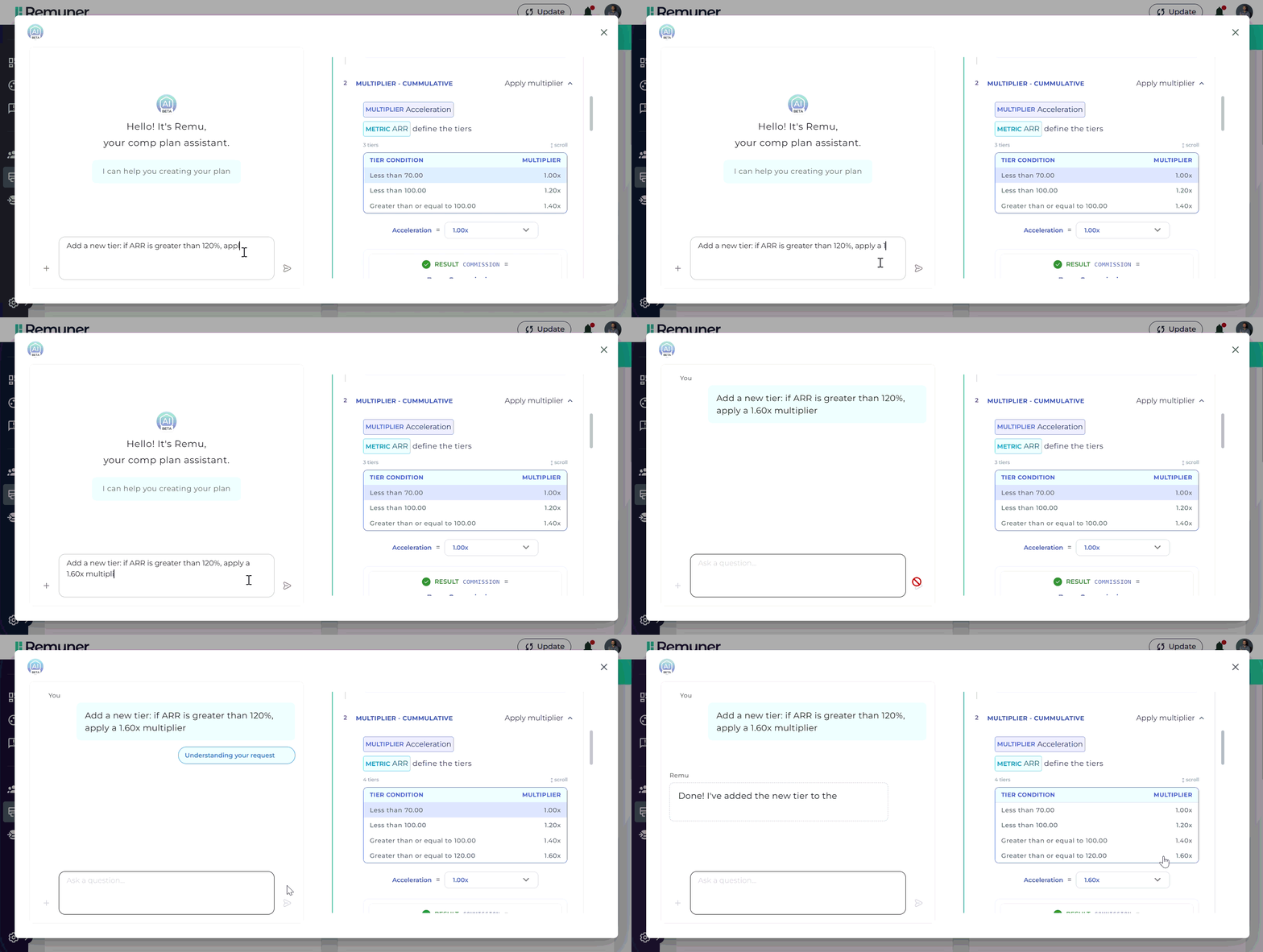
Remuner is an AI-powered variable compensation platform built for teams that want commissions to be automated and to actively drive performance. Where many tools stop at calculating and reporting, Remuner adds Remu, an AI compensation manager that gives each rep personalized earnings simulations, performance insights, and concrete guidance on how to increase what they take home.
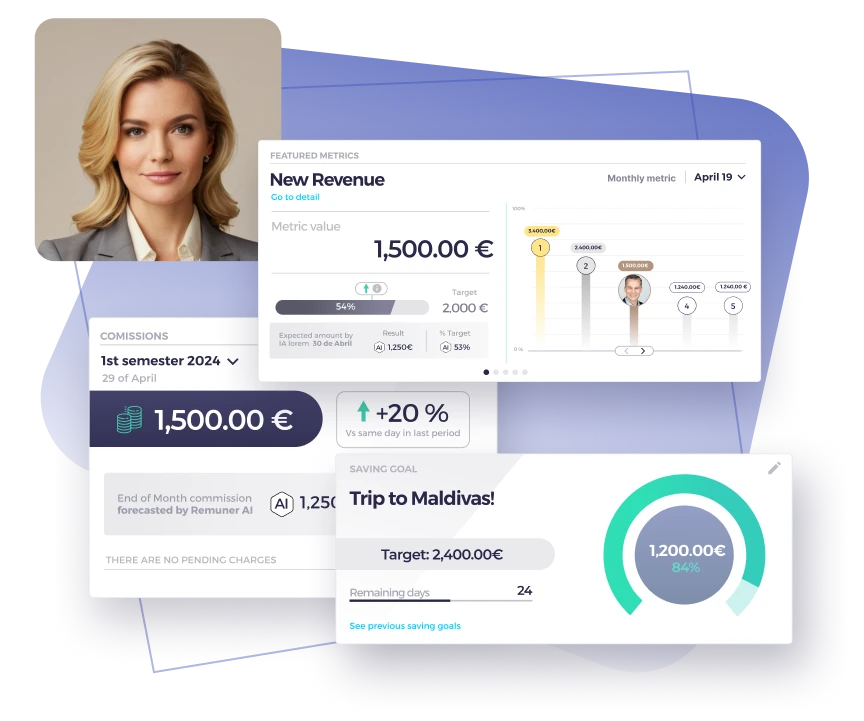
Its no-code designer module lets operations, finance, and sales ops build and adapt any compensation plan — from a simple flat rate to the most intricate multi-tier, split, and accelerator logic — without depending on IT, developers, or external consultants. That flexibility is a core design principle: the platform is meant to handle whatever structure your business requires, not just standardized plans. Real-time dashboards give every rep full transparency into earnings and targets, while finance gets automated, error-free calculations, faster payout cycles, and clean statements that cut disputes. Native integrations with HubSpot, Salesforce, and 20+ other tools keep data flowing automatically — no middleware, no manual imports, and none of the data-lag Qobra reviewers report.
What makes Remuner different:
- An AI coach, not just analytics: Remu simulates earnings, answers rep commission questions in plain language, helps build comp plans from scratch, and tells each rep exactly how to earn more — turning the compensation tool into a motivation engine.
- No-code design for any plan complexity: Build and change plans of any structure independently, with no reliance on other teams or consultants.
- Real-time automation: Automated calculations, period validation, and claim and override management remove manual work and error.
- Deep, native integrations: Remuner connects with 20+ tools including HubSpot CRM and Sales Hub, Salesforce, NetSuite, Pipedrive, Odoo, Personio, Stripe, and Snowflake — keeping data accurate across teams regardless of your stack.
- Ratings and trust: Remuner holds a 4.9/5 rating on G2 across 119 reviews, and the Barcelona-based company raised $6.5M to expand its AI-driven approach across Europe.
Why teams pick Remuner over Qobra: the exact areas Qobra reviewers flag — data freshness, reporting flexibility, and manual work — are where Remuner’s own G2 reviewers say it delivers:
“Remuner seamlessly connects with our CRM and allows us to map data however we want… The initial setup was very easy and straightforward… Remuner replaces the need for spreadsheet and manual commission tracking and calculation, saving a lot of time for both the sales reps and the finance team.” — Krystian K., Sales Operations Lead at Singu, Mid-Market (G2 review)
Across reviews, users consistently praise Remuner’s clarity, ease of use, real-time visibility, and the motivation that comes from reps seeing their earnings update live — the same real-time promise Qobra makes, but without the mobile and data-lag caveats. See how CoverManager went from Excel and distrust to a team that checks its commissions in real time.
Ideal for: CommEx-led, Sales-led and RevOps-led teams in Europe — that want automation plus a measurable lift in rep performance, across plans of any complexity.
Pricing: Custom, based on team size and needs, with ROI framed around large reductions in commission-management cost and time.
Remuner reports customers save a substantial share of commission-management time and cost after switching, while improving performance through smarter incentive alignment. Discover how Remuner works.
2. CaptivateIQ
CaptivateIQ pairs a spreadsheet-style no-code builder (SmartGrid) with a powerful calculation engine, and extends well beyond commissions into quota setting, territory carving, capacity modeling, and predictive analytics.
Its Assist AI supports natural-language plan building, and it was named a 2025 Forrester Wave Leader for Sales Performance Management. It is a strong fit for RevOps and finance teams managing many complex plans with dedicated comp resources, though pricing is custom and often perceived as high, and implementation averages around three months.
3. Everstage
Everstage is a well-reviewed platform offering flexible plan modeling, automated calculations, quota management, forecasting with scenario planning, dashboards, and leaderboards. It is popular with mid-market and enterprise Operations and Finance teams that value workflow flexibility and a buyer-friendly evaluation process. Pricing is custom (demo required), and some reviewers report occasional calculation issues that need manual correction.
4. Salesforce Spiff
Now part of Salesforce, Spiff delivers incentive compensation management natively inside the CRM, with commission tracing, audit trails, and real-time rep visibility. For teams standardized on Salesforce, it removes the export-and-reconcile step by keeping deal data and comp logic in one place.
Published entry pricing sits around $75/user, though non-Salesforce connectors and premium support add meaningful cost, and teams on HubSpot or other CRMs should evaluate integration depth carefully.
5. QuotaPath
QuotaPath centers on rep-facing earnings visibility and fast time-to-value, with AI-powered plan building, 20+ CRM/ERP integrations (including HubSpot and Salesforce), and ASC 606 / ASC 340-40 compliance. It is one of the few vendors that publishes per-user pricing (roughly $25–$50/user/month across tiers), making it a strong pick for SMB and scaling teams that want clarity and predictable budgets. It is less suited to the most extreme plan complexity.
6. Xactly Incent
One of the original enterprise ICM players, Xactly shines on audit trails, ASC 606 commission expensing, forecasting, and the governance that public-company finance teams demand, with proprietary benchmarking data drawn from years of commission calculations. It is right-sized for large, complex, compliance-heavy organizations, but implementation timelines and total cost of ownership run higher, and some teams report a steeper learning curve.
7. Performio
Performio focuses on data flexibility and sales performance management, ingesting commission-relevant data from a wide range of sources — CRMs, ERPs, spreadsheets, and custom databases — with real-time insights, commission tracking, and customizable workflows. It fits mid-sized to large organizations with high transaction volumes and complex, multi-source data environments, though the interface can require more training than newer platforms.
8. Forma.ai
Forma.ai uses AI-powered analytics to model different compensation scenarios and assess plan effectiveness, leading the category on AI-driven payout forecasting. It is best suited to data-mature enterprises that want to model and optimize comp strategy at scale, and is more enterprise-oriented than a fit for lean teams.
9. Varicent
Varicent offers a broad enterprise SPM suite spanning territory planning, quota management, and commission calculation, with strong customization and analytics. For large organizations where commissions are tightly linked to territory and quota, it provides an integrated approach — at enterprise pricing and with a longer deployment cycle.
10. Xoxoday Compass
Compass goes beyond commissions to manage SPIFFs, bonuses, and contests in one system, with strong gamification and visibility. It fits teams (roughly 100–500 reps) running diverse incentive programs, not just commissions; for pure commission automation, a more focused platform typically deploys faster.
Feature comparison table
How Remuner and the top Qobra alternatives stack up on the features that actually decide a switch.
G2 scores, pricing, and positioning are compiled from G2, each vendor’s public pricing pages, and independent vendor comparisons as of August 2026. Confirm current figures and total cost of ownership directly with each vendor.
Migration checklist: switching from Qobra
Switching commission platforms rewards careful planning. Use this checklist to structure your move:
1. Audit your current plans
- Document every active plan, including tiers, splits, accelerators, SPIFFs, and exceptions.
- Flag which plans are standard and which use custom logic or manual overrides.
- Export at least the last 12 months of commission data.
2. Map your data sources
- List every system feeding your calculations (CRM, ERP, HRIS, spreadsheets).
- Document fields, sync frequency, and any transformations applied.
- Fix data-quality issues before you migrate — garbage in, garbage out.
3. Define your requirements
- Prioritize the criteria from the “What to prioritize” section above.
- Identify must-have integrations, compliance needs, and reporting requirements.
- Set a target go-live date and work backward.
4. Evaluate and select
- Request demos using your own plans, not generic demo data.
- Ask each vendor to walk through how a specific plan change is made post-implementation.
- Request references from customers with similar team size and plan complexity.
5. Plan the implementation
- Confirm whether implementation is handled in-house or requires third-party consultants.
- Set up a parallel-run period where both systems calculate simultaneously.
- Define acceptance criteria: what must match before cutover.
6. Validate and go live
- Run parallel calculations for at least one full pay period.
- Reconcile old vs. new at the individual transaction level.
- Train reps, managers, and finance before cutover, and communicate the switch clearly.
Frequently Asked Questions
What is the main reason teams switch from Qobra?
Qobra is well-liked for its ease of use and real-time visibility, so teams rarely leave because they dislike it — they leave when they need more. The most-cited reasons in reviews are a weaker mobile experience, occasional delays in data updates, limited dashboard customization and filtering, and a learning curve as plans get more complex. Teams also switch when they want AI that does real work — building plans and coaching reps — rather than just analytics.
How long does it take to migrate from Qobra to a new platform?
It depends on the platform. Enterprise tools like Xactly or Varicent can take 3–6 months, while most teams go live on Remuner in under four weeks — including migrating historical data and running a parallel calculation before cutover. A big reason it’s so fast: instead of rebuilding your old plans cell-by-cell, Remu AI can take your go-to-market motion and quota structure and build a working comp plan in hours, turning migration into a chance to simplify rather than just relocate complexity. Timing the switch to a period boundary keeps payouts clean.
Can I keep my existing commission plans when I switch?
Yes. A well-designed platform should replicate your existing plans during implementation. The key question is whether you can rebuild and adjust them yourself with a no-code builder — as you can in Remuner, across any plan complexity — or whether you’ll depend on the vendor’s services team for every change afterward.
How do I compare total cost of ownership across platforms?
Look beyond the annual license fee. Factor in implementation costs, the cost of making plan changes post-launch, per-user pricing tiers that scale with headcount, and any charges for extra integrations or support. Ask each vendor for a three-year total-cost projection including all foreseeable fees.
Which Qobra alternative has the best AI capabilities?
Remuner. Its AI compensation manager, Remu, works alongside your team rather than just reporting to it: it answers reps’ commission questions in plain language (“How much did I earn on the Acme deal?”), gives each rep earnings simulations and personalized guidance on how to earn more, helps RevOps and Finance design and build comp plans from scratch, models payout scenarios before rollout, surfaces forecasts before month-end, and flags calculation errors before they turn into disputes.
What should I look for in a commission platform’s audit trail?
A strong audit trail lets finance trace every calculation back to the source — the deal record, the plan rule that triggered it, and the payout amount. Look for transaction-level detail, version history on plan changes, and exportable reports that support compliance and reconciliation.
Ready to switch?
Qobra is a capable platform, but it isn’t the only strong option — and it may not be the best fit for your team’s size, budget, plan complexity, or CRM. If you want automation that also drives performance, Remuner stands out: no-code plan design that handles any complexity, real-time transparency, deep native integrations, and an AI coach that shows every rep exactly how to earn more.
Ready to see the difference? Book a Remuner demo and see how AI-powered compensation can cut admin time and lift team performance.