




CaptivateIQ built its name on a flexible, spreadsheet-inspired approach to incentive compensation management (ICM). For finance teams already comfortable in Excel, the platform feels familiar — and its implementation timeline of roughly three months is faster than some enterprise alternatives.
But as sales teams grow and compensation plans get more complex, that same flexibility starts creating friction. Mid-market companies consistently report the same pain points: a steep learning curve, heavy reliance on vendor support for plan changes, and a commission process that requires either technical expertise or paid professional services to maintain.
Here are the 10 best CaptivateIQ alternatives — what each does well, who it’s best for, and why Remuner comes out ahead as the most complete option.
Why Teams Look for CaptivateIQ Alternatives
1. Professional services dependency. Most plan modifications require paid PS hours or deep technical expertise — teams that want to iterate plans quarterly find themselves blocked.
2. Long implementation timelines. The average CaptivateIQ implementation runs 2–4 months, a competitive disadvantage for fast-growing companies.
3. Learning curve for non-technical users. The spreadsheet-style interface requires significant training for Sales ops and RevOps managers without formula-building experience.
4. Limited real-time rep visibility. Commission statements aren’t always current, creating disputes and reducing the motivational impact of variable pay.
5. Pricing scales steeply. As headcount grows, the per-seat model becomes expensive relative to flat-rate alternatives.
The 10 Best CaptivateIQ Alternatives in 2026
1. Remuner — the most complete CaptivateIQ alternative
Best for: Any RevOps or Finance team that wants CaptivateIQ’s plan flexibility without its PS dependency — from fast-growing startups to multi-country enterprises.
Of the ten platforms in this comparison, Remuner is the only one that combines full no-code plan design, true self-serve implementation, and a built-in AI layer that actively works alongside your team rather than just reporting back to it. Its no-code plan designer lets admins build and modify comp plans — including multi-metric, tiered, and gamified structures — without technical support, while native integrations with Salesforce, HubSpot, and major CRMs mean data flows automatically with no manual imports or middleware.
The standout feature is Remu AI, an embedded AI agent that goes well beyond answering reps’ commission questions in natural language (“How much did I earn on the Acme deal?”). Remu AI also helps RevOps and Finance teams design and build compensation plans from scratch — suggesting plan structures based on your go-to-market motion, modeling payout scenarios before you roll a plan out, surfacing forecasts before month-end, and flagging calculation errors before they become disputes.
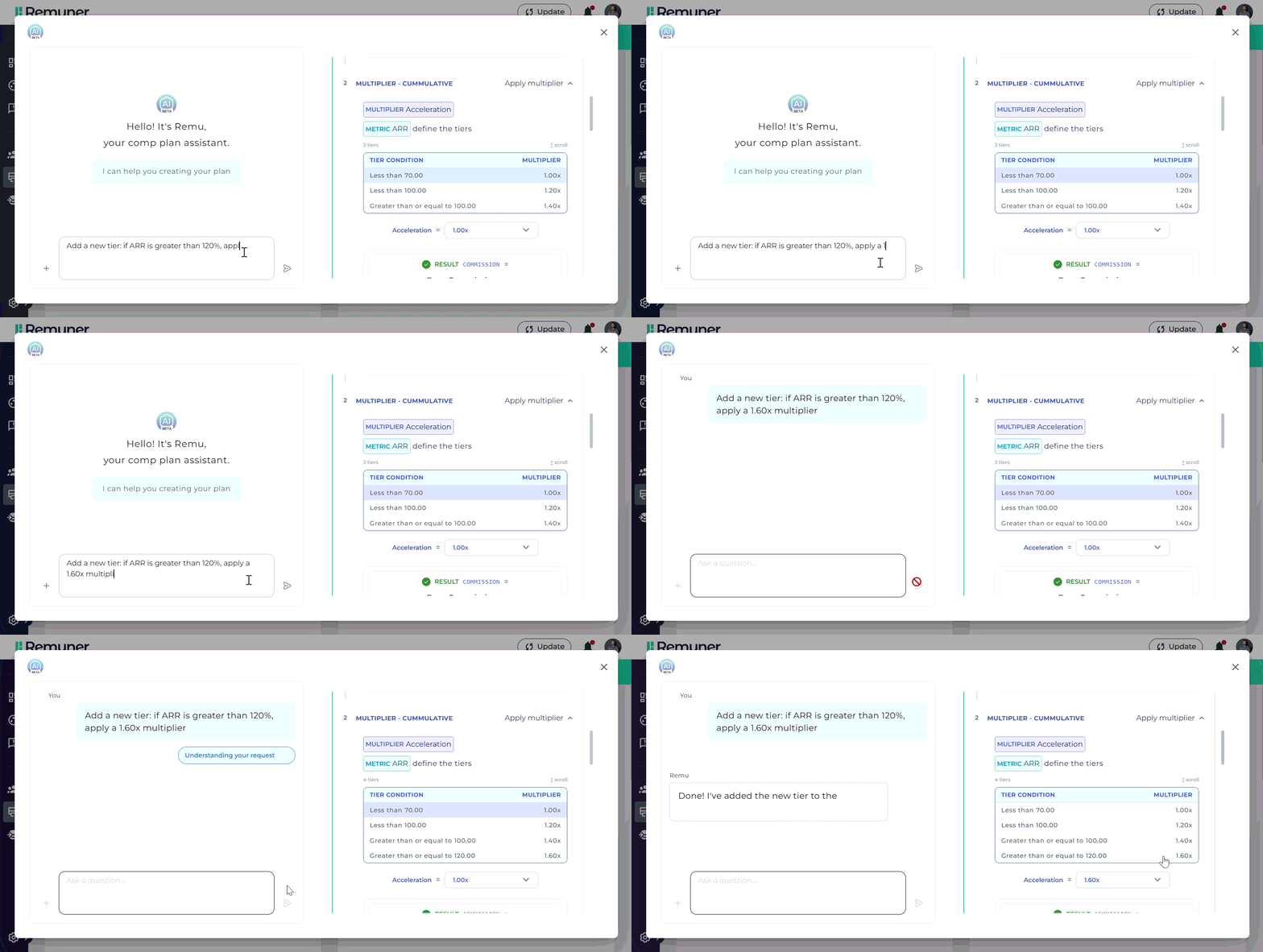
Key differentiators vs. CaptivateIQ:
- No PS required for plan changes or plan building
- Native integrations (no middleware)
- Remu AI for both plan design and real-time rep visibility
- Go-live in under 4 weeks
Remuner’s support doesn’t stop at go-live, either. Mention Me’s RevOps team called out the hands-on help they get building plans on tight deadlines:
“The team at Remuner have been amazing. I don’t think a lot of other providers can provide that kind of level of support, particularly in a time where we’re moving so quickly.” — Antonio Worner, RevOps Lead at Mention Me
🏆 G2 Best Support — Sales Compensation | G2 Spring Reports 2026
If you want to see how your own compensation plans would look like at Remuner, book a demo here.
2. Everstage
Best for: RevOps-led teams that want strong analytics and gamification.
Everstage combines solid ICM functionality with a rep-facing experience that drives engagement — leaderboards, nudges, and real-time earnings forecasts. Implementation typically takes 6–8 weeks with minimal PS support for standard plans.
Limitations: Can get expensive at scale; complex multi-tier plans may need support; plan building still leans on the team rather than an AI assistant. See the full Remuner vs. Everstage comparison →
3. QuotaPath
Best for: SMB and fast-growing mid-market teams that want self-serve onboarding.
Most teams go live within a week using the self-serve flow. Covers common plan types (quota-based, tiered, MBO) well, with an AI-assisted plan builder for new structures.
Limitations: Less suited for complex multi-currency or multi-entity enterprise plans. See the full Remuner vs. QuotaPath comparison →
4. Xactly Incent
Best for: Large enterprise with complex global comp structures.
The incumbent in enterprise ICM. Handles multi-currency, multi-country, multi-entity plans with deep integrations for SAP, Workday, and Oracle. For 500+ reps across multiple geographies with compliance requirements, Xactly has the depth. Tradeoff: 3–6 month implementation, PS required, dated interface.
Limitations: High cost, long implementation, requires technical admin.
5. Performio
Best for: Finance-led teams with compliance and audit requirements.
Built with finance as the primary user. Strong audit trails, SOX compliance support, and detailed reporting for period-end close.
Limitations: Basic rep-facing experience; less focus on sales team engagement.
6. Salesforce Spiff
Best for: Companies fully standardized on Salesforce.
Acquired by Salesforce in 2024. Commissions appear inside the CRM alongside deal records — fastest setup for Salesforce shops.
Limitations: Locked into Salesforce ecosystem; limited value if you use HubSpot or another CRM.
7. Varicent
Best for: Enterprise teams needing ICM plus sales performance analytics.
Goes beyond commissions into territory planning, quota setting, and revenue performance management — a single platform for the entire sales planning cycle.
Limitations: Expensive, complex to implement, overkill for commission-only use cases.
8. Anaplan
Best for: Enterprises needing comp as part of a broader FP&A platform.
Not primarily an ICM tool — sales compensation is one module in a connected planning platform used for budgeting and workforce planning.
Limitations: Not purpose-built for ICM; complex, expensive; limited rep experience.
9. SAP Commissions
Best for: Large enterprises already running SAP ERP.
The natural choice for SAP ecosystems. Handles multi-country, high-volume commission processing with strong compliance features. Poor fit outside SAP environments.
Limitations: Very high cost and complexity; poor fit outside SAP ecosystems.
10. Iconixx
Best for: Mid-market companies with moderately complex plans.
A solid mid-market ICM handling standard comp structures (quota attainment, tiered accelerators, SPIFs, MBO) without the enterprise price tag. Configurable rules engine, decent reporting, typically 6–10 weeks to implement.
Limitations: Less AI-driven than newer platforms; basic rep visibility.
Product Feature Comparison
How Remuner and the top CaptivateIQ alternatives stack up on the features that actually decide a switch.
Feature data compiled from each vendor’s public product pages and independent vendor comparisons as of August 2026.
Why Switch From CaptivateIQ — And What You Need to Do
Teams don’t switch commission platforms on a whim. It’s usually one of the five pain points above hitting a breaking point: a plan change stuck waiting on professional services, a quarter where reps stopped trusting their commission statements, or a renewal that made the per-seat pricing impossible to justify.
Here’s what actually matters once you’ve decided to make the move:
1. Get plan ownership back in-house. If every plan change routes through PS, you’re not really in control of your own compensation strategy. Look for a no-code plan designer — like Remuner’s — where RevOps or Finance can build and test a new plan without opening a support ticket.
2. Let AI build the plan, don’t just port over the old spreadsheet logic. The easiest switches aren’t the ones where you recreate your old CaptivateIQ plan cell-for-cell. Remu AI can take your go-to-market motion and quota structure and propose a plan from scratch, so migration becomes a chance to simplify, not just relocate complexity.
3. Migrate your historical data, not just the go-forward plan. Reps need to see their commission history, not only future payouts, for the switch to feel seamless. Confirm your new platform can import historical commission and deal data before cutover.
4. Time the cutover to a period boundary. Switch at the start of a new comp period — quarter or month — so you’re not reconciling two systems mid-cycle. Most Remuner migrations go live in under four weeks, timed to line up with the next period close.
5. Run a parallel calculation before go-live. Before retiring your old platform, run one commission cycle in parallel in the new system and compare payouts line by line. It’s the fastest way to build trust with reps and finance before the old system goes dark.
6. Loop in support early, not just for onboarding. Mention Me’s RevOps lead credits Remuner’s team for helping build plans “in a time where we’re moving so quickly” — the right partner should be hands-on through the switch, not just during the sales process.
→ Book a migration consultation with Remuner
Frequently Asked Questions
Why are companies switching from CaptivateIQ?
The most common reasons are professional services dependency for plan changes, implementation and iteration timelines that don’t match how fast sales orgs actually move, and rep-facing commission visibility that lags behind what teams need to keep trust between sales and finance intact.
How long does it take to switch from CaptivateIQ to another platform?
It depends on the vendor. Enterprise platforms like Xactly or Varicent can take 3–6 months to implement. Remuner is on the faster end — most teams go live in under four weeks, including migrating historical data and running a parallel calculation before cutover.
Will switching commission platforms disrupt payouts mid-quarter?
It shouldn’t, if the cutover is timed correctly. The safest approach is to switch at the start of a new comp period and run one cycle in parallel across both systems before fully retiring the old one.
What happens to historical commission data when you switch?
A good migration imports historical commission and deal data alongside the go-forward plan, so reps can still see past payouts in the new system. Ask any vendor you’re evaluating how they handle historical data import before you sign.
Does Remuner integrate with Salesforce and HubSpot?
Yes — Remuner has native integrations with Salesforce and HubSpot, plus other CRMs via API, so deal data flows in automatically without middleware or manual imports.
How is Remuner different from CaptivateIQ?
Remuner eliminates the PS dependency for both plan changes and plan building, adds Remu AI for real-time rep visibility and AI-assisted plan design, and goes live in under 4 weeks. Remuner vs. CaptivateIQ comparison.
Sources: G2, Capterra, Gartner Peer Insights, Vendr, SoftwareWorld (July 2026)