




💡 Quick answer: European sales teams have compensation needs that US-first tools handle awkwardly: GDPR-compliant handling of employee earnings data (ideally hosted in the EU), multi-currency payouts across countries, correct VAT treatment of commissions where reps invoice as contractors, and plans that respect very different country-by-country norms for base/variable split, works councils, and payroll. The best sales compensation software for European companies is built for this from the ground up — not retrofitted. Remuner is EU-native, which is why European teams increasingly choose it over US incumbents.
If you run sales compensation for a European company — or a US company with European reps — you’ve probably hit the moment where a slick US commission tool quietly doesn’t fit. It assumes dollars, US payroll, US data norms, and one uniform sales culture. Europe is none of those things. This guide covers what actually makes sales compensation different in Europe, and what to look for in software that’s genuinely built for it.
Why “US-first” sales comp tools struggle in Europe
Most of the well-known commission platforms were built in and for the US market. They work — but Europe introduces requirements they often bolt on rather than design for:
- Data-protection rules (GDPR) that treat compensation data as sensitive personal data.
- Multiple currencies within a single sales team.
- Contractor/agent arrangements where VAT enters the picture.
- Wildly different country norms for how sellers are paid — and who has to be consulted about it.
None of these are edge cases in Europe; they’re the baseline. Here’s each in turn.
1. GDPR and data residency
Compensation data — earnings, quotas, performance — is personal data about employees, and in Europe that puts it squarely under GDPR. That has real implications for your tooling:
- Lawful basis and access control. Who can see a rep’s earnings, and why, has to be controlled and defensible.
- Data residency. Many European companies (and their works councils) strongly prefer, or require, that employee data is hosted in the EU rather than shuttled to US servers.
- Data-subject rights. Reps can request access to, and correction of, the data held about them.
- Certified security. An ISO 27001 certification is independent proof that a vendor manages information security to a recognised standard — a strong signal when the data in question is employee earnings.
A platform built with EU data protection in mind — EU hosting, ISO 27001-certified security, GDPR-aligned processing, and proper access controls — removes a whole compliance headache. A US-first tool can often be made compliant, but it’s on you to verify where the data lives and how it’s processed.
Data residency and security also intersect with the incoming EU Pay Transparency Directive, which requires employers to report gender pay gaps across both fixed and variable pay — making auditable, well-governed compensation data a compliance requirement, not just good practice.

2. Multi-currency payouts
A European sales team routinely spans the eurozone plus the UK (GBP), Switzerland (CHF), the Nordics (SEK, NOK, DKK), Poland (PLN), and more. That means a single comp plan has to:
- Set quotas and pay commissions in each rep’s local currency.
- Handle exchange-rate treatment consistently (which rate, at which date) so cross-border comparisons and company-level reporting are accurate.
- Feed the right numbers into multiple local payrolls.
Tools that assume a single currency force finance into manual FX gymnastics every period. Native multi-currency support is table stakes for a European deployment. Remuner’s multi-currency module lets teams set one currency per market, or combine several, and rolls everything up into consistent company-level reporting.
3. VAT treatment of commissions
This one catches teams out. In several European markets, sales agents (particularly self-employed reps, brokers, and some channel partners) invoice their commission and charge VAT on it. Employed reps’ commission runs through payroll and is treated as employment income; a self-employed agent’s commission is a service that may be VAT-able.
Getting this wrong creates tax and accounting problems. Software used in Europe needs to accommodate the distinction between employee commission (payroll) and agent commission (invoiced, potentially VAT-bearing) rather than assuming everyone is a W-2-style employee.
4. Country-by-country norms
There’s no single “European” way to pay salespeople. The base/variable split, the role of guarantees, and the governance around comp changes vary sharply:
- UK — closest to US-style aggressive variable pay; higher variable proportions and OTE-driven plans are common.
- France — often a larger fixed-salary component, strong employee protections, and works-council (CSE) involvement in changes to variable pay schemes.
- Germany — significant works-council (Betriebsrat) influence; comp changes can require consultation, and there’s a cultural preference for stability.
- Spain — commonly a solid base with variable on top; specific rules around how variable pay is consolidated.
A plan that’s normal in London can be a non-starter in Frankfurt without consultation. Software that lets you run different plan structures per country — and document changes for local governance — is essential.
What to look for in European sales comp software
- EU data residency and GDPR-aligned processing, with clear answers on where data is hosted.
- Native multi-currency quotas, payouts, and reporting.
- Flexibility for employee vs agent commission (payroll vs invoiced/VAT).
- Per-country plan configuration via a no-code builder, so local norms and governance are respected.
- Local-language support and a team that understands European sales culture.
- Native integrations with the CRM/ERP stack you run.
Why European teams choose Remuner
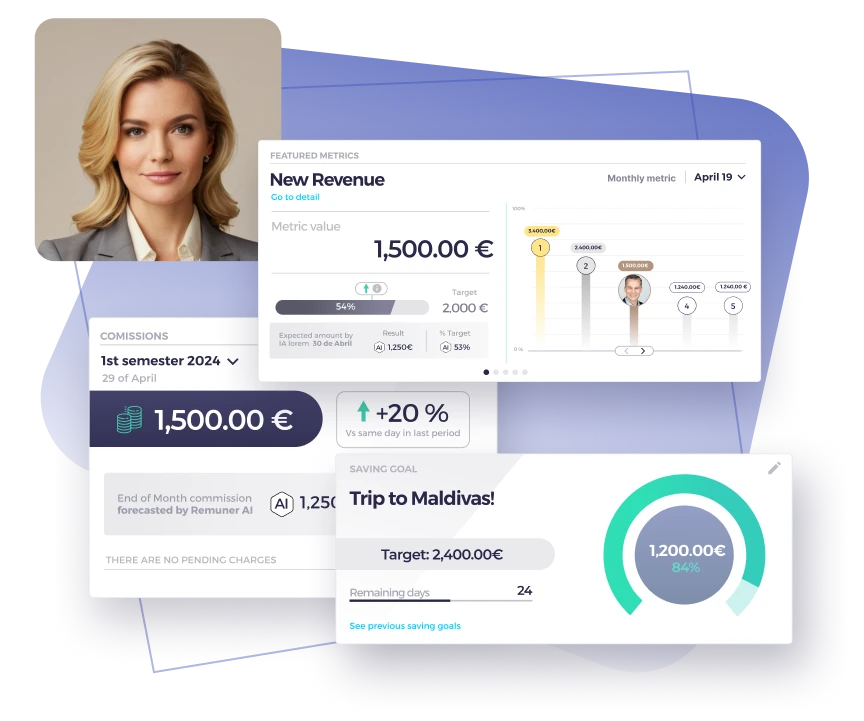
Remuner is EU-native — built in Europe, for European sales teams, rather than a US product adapted after the fact. That shows up where it matters: EU data handling backed by ISO 27001-certified security and GDPR alignment, multi-currency payouts across European markets, flexibility for the employee-vs-agent distinction, and a no-code plan designer that lets you run different plan structures per country while keeping every change auditable for local governance.
EU-native doesn’t mean harder to adopt — the opposite. As Krystian Kuta, Sales Operations Lead at Singu, put it: “I’ve implemented a dozen tools… Remuner was hands down the best onboarding I’ve ever had.”
For US-headquartered companies with European reps, and for European companies tired of forcing a US tool to fit, that EU-first design is the differentiator. For the wider category context, see our guide to incentive compensation management.
Frequently asked questions
What is the best sales compensation software for European companies?
The best fit is a platform designed for European requirements — GDPR-aligned with EU data residency, native multi-currency, per-country plan flexibility, and support for both employee and agent (VAT-invoiced) commission. Remuner is EU-native and built specifically for this.
Is US commission software GDPR-compliant?
It can be, but the burden is on you to verify where employee data is hosted and how it’s processed. EU-native tools handle data residency and GDPR-aligned processing by design, which removes much of that risk.
Is sales compensation data secure in Remuner?
Yes. Remuner is ISO 27001 certified, hosts data in the EU, and applies GDPR-aligned processing with role-based access controls — so employee earnings data is managed to an independently audited security standard.
Does European sales comp software help with the EU Pay Transparency Directive?
Indirectly, but importantly. The Directive requires employers to report pay gaps across fixed and variable components. Software that keeps commission and bonus data structured, auditable, and centralised makes that reporting far easier than reconstructing it from spreadsheets each period.
How does sales compensation software handle multiple currencies?
Good European tools set quotas and pay commissions in each rep’s local currency, apply a consistent exchange-rate treatment, and still roll everything up into accurate company-level reporting — without manual FX work each period.
Do sales commissions have VAT in Europe?
It depends on the arrangement. Employed reps’ commission is employment income via payroll; self-employed agents and some partners invoice their commission and may charge VAT. Your software should support both cases.
Why do country norms matter for comp plans in Europe?
Base/variable splits, guarantees, and governance differ by country — France and Germany often involve works councils in variable-pay changes, for example. Running different plan structures per country, with documented changes, keeps plans both effective and compliant.
Running sales compensation across European markets? See how Remuner handles GDPR, multi-currency, and per-country plans. Book a free demo now!