



💡 Quick answer. The best Everstage alternatives in 2026 are Remuner, CaptivateIQ, QuotaPath, Qobra, Salesforce Spiff, Xactly Incent, Performio, Forma.ai, Varicent, and Xoxoday Compass. Everstage is well-liked for its rep dashboards and gamification, but teams switch when they need AI that acts on compensation data rather than just displaying it, deeper self-serve plan control, and pricing that works for smaller teams. Among them, Remuner stands out for teams that want that operational layer: it’s an AI-native variable compensation platform (rated 4.9/5 on G2) whose AI compensation manager, Remu, builds plans, answers rep questions in plain language, and flags calculation errors before payout — the work other tools leave to your team. It’s a particularly strong fit for CommEx-, sales-, and RevOps-led teams in Europe, across plans of any complexity.
If your operations, finance, or sales team runs commissions on Everstage, you already know what it’s good at: reps like the dashboards, the leaderboards drive engagement, and the day-to-day experience earns its high ratings. The question a growing number of teams are asking in 2026 isn’t whether Everstage motivates — it’s whether the platform does anything with the data once it has your attention. When a payout looks wrong, someone in RevOps still investigates by hand. When finance needs a liability forecast, they build it themselves. That gap — between a platform that shows performance and one that acts on it — is what’s driving teams to weigh Everstage alternatives, alongside the need for deeper self-serve control, real AI, and a platform that scales with them.
This guide walks through the 10 best alternatives to Everstage, explains why teams decide to switch, and gives you a framework for choosing the platform that fits your organization. Whether you’re in operations building plans, in finance reconciling payouts, or in sales leadership looking for transparency that motivates reps, this article is structured to help you make an informed decision. We cover each platform’s positioning, strengths, and ideal use case — starting with Remuner, the highest-rated platform on this list — followed by a feature comparison table, a migration checklist, and answers to the questions teams ask most when switching.
Why look for an Everstage alternative?
Everstage’s rep experience is genuinely strong — that’s not in dispute, and it’s why the platform rates so well. The gaps show up once you look past the leaderboard.
1. The AI shows and suggests; it doesn’t act. Everstage’s intelligence is built around visibility, forecasting, and gamification. What it doesn’t do is proactively catch a calculation error before payout, model the cost of a plan change before you approve it, or resolve a rep dispute without a person doing the legwork. For RevOps and finance teams, that means the tool motivates reps but leaves the operational work — investigation, forecasting, reconciliation — exactly where it was.
2. Reporting customization is limited, and plan changes route through the vendor. Teams expecting full self-serve plan administration are a recurring source of frustration: reviewers cite reporting-customization limits and vendor-assisted configuration, meaning some plan changes go back through Everstage rather than being handled in-house. Reviewers also note that customizing reports for non-standard needs — ad hoc analysis by geography, plan type, or product line — often means exporting to spreadsheets. RevOps and finance teams that want to iterate plans independently feel this first.
3. Enterprise deployments can still run into months. Everstage advertises a fast go-live, and for many mid-market teams it delivers. But larger or more complex rollouts commonly extend well past the weeks-long timelines teams expect in 2026 — and there’s a learning curve on the more advanced configurations and reporting that lengthens time-to-value for sophisticated plans.
4. Pricing is quote-only, per payee, and prices out smaller teams. Everstage uses custom, usage-aligned pricing that requires a demo before you see a number, sold per payee with an annual commitment and an implementation fee, scaling with payee count and plan complexity. That’s standard for the category — but it’s also the number-one reason smaller teams start hunting for alternatives, since a lean sales team rarely justifies a five-figure ICM contract.
What Everstage’s own reviews say. Everstage earns consistently high marks — 4.8/5 on G2 across ~2,100 reviews — with users praising ease of use, transparency, intuitive dashboards, and real-time earnings visibility that keeps reps motivated. On the downside, the recurring themes are reporting-customization limits, vendor-routed plan changes, an AI layer that reports rather than acts, and a learning curve on complex setups. The pattern: reps love the day-to-day experience, while the friction concentrates in self-serve flexibility, finance-grade automation, and complex-plan onboarding.
What to prioritize in an Everstage replacement
When evaluating alternatives, focus on the criteria that address what’s actually pushing you to switch:
- Self-serve plan control: Can your ops team build, modify, and test any plan without routing changes back through the vendor?
- AI that acts, not just reports: Does the platform’s AI actually do the work — build plans, answer rep questions in plain language, flag calculation errors before payout, and model a plan change before you approve it — or does it only visualize performance?
- Customizable reporting and filtering: Can each team shape its own dashboards and reports rather than living within fixed views?
- Finance-grade depth alongside the rep experience: Are audit trails, ASC 606 support, and liability forecasting defaults, not upsells?
- Fast, reliable implementation: Is go-live measured in weeks, with a partner that stays hands-on through cutover?
- Integration depth: Does it sync natively and in real time with your CRM (HubSpot, Salesforce, Pipedrive), ERP, and HRIS?
- Total cost of ownership: Look past the license fee to implementation, plan-change costs, and support tiers — these often cost more than the license itself.
The 10 best Everstage alternatives in 2026
1. Remuner
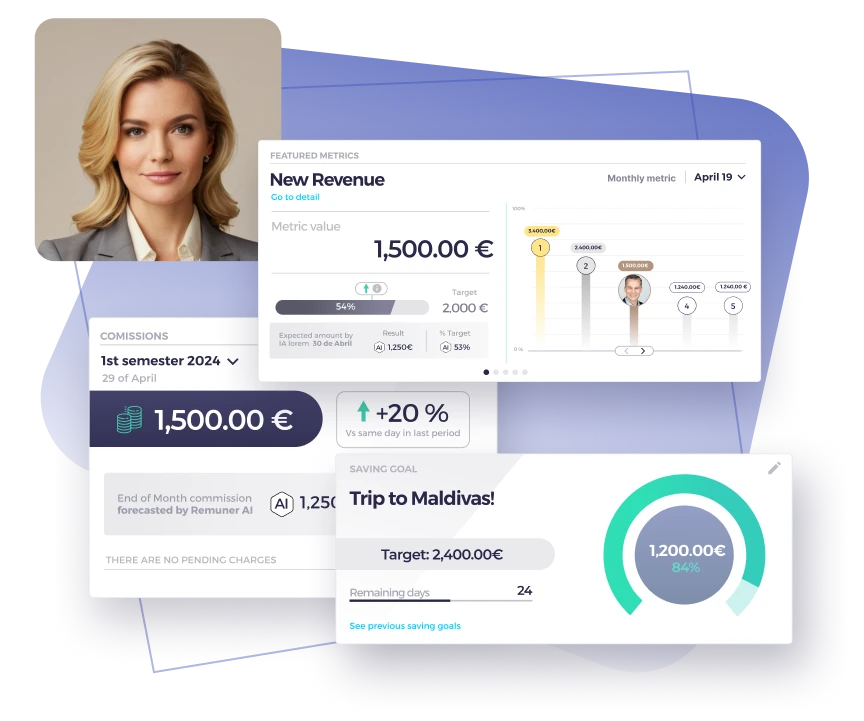
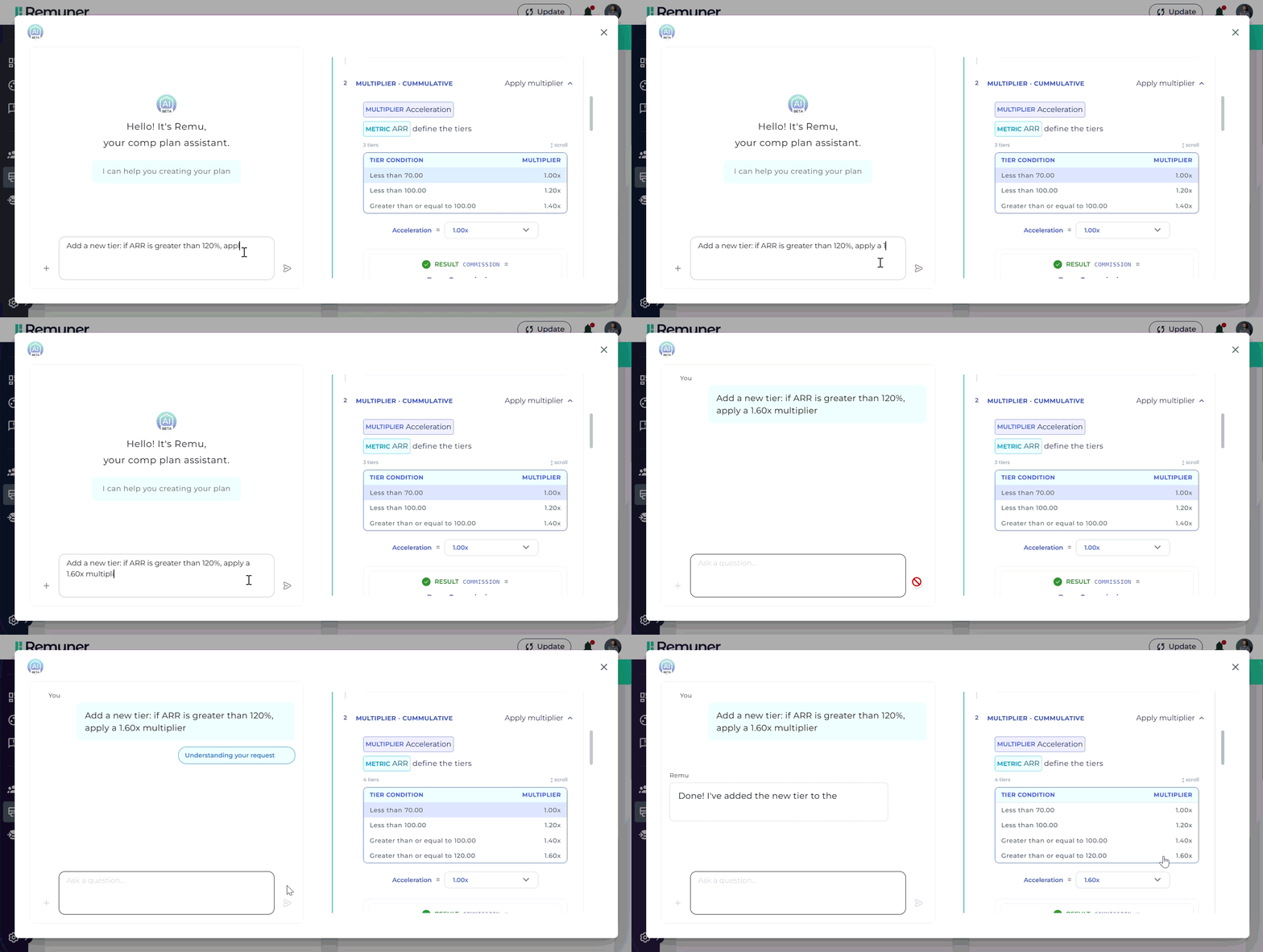
Remuner is an AI-powered variable compensation platform built for teams that want commissions to be automated and to actively drive performance. Where many tools stop at calculating and reporting, Remuner adds Remu, an AI compensation manager that gives each rep personalized earnings simulations, performance insights, and concrete guidance on how to increase what they take home.
Its no-code designer module lets operations, finance, and sales ops build and adapt any compensation plan — from a simple flat rate to the most intricate multi-tier, split, and accelerator logic — without depending on IT, developers, or external consultants. No plan change routes back through the vendor. Real-time dashboards give every rep full transparency into earnings and targets, while finance gets automated, error-free calculations, faster payout cycles, and clean statements that cut disputes. Native integrations with HubSpot, Salesforce, and 20+ other tools keep data flowing automatically — no middleware, no manual imports.
What makes Remuner different:
- An AI compensation manager, not just analytics: Remu simulates earnings, answers rep commission questions in plain language, helps build comp plans from scratch, flags calculation errors before they become disputes, and tells each rep exactly how to earn more — doing the operational work Everstage’s AI leaves to your team.
- No-code design for any plan complexity: Build and change plans of any structure independently, with no reliance on other teams or consultants.
- Real-time automation: Automated calculations, period validation, and claim and override management remove manual work and error.
- Deep, native integrations: Remuner connects with 20+ tools including HubSpot CRM and Sales Hub, Salesforce, NetSuite, Pipedrive, Odoo, Personio, Stripe, and Snowflake.
- Ratings and trust: Remuner holds a 4.9/5 rating on G2 across 119 reviews, and the Barcelona-based company raised $6.5M to expand its AI-driven approach across Europe.
Why teams pick Remuner over Everstage: the exact areas Everstage reviewers flag — self-serve control, reporting flexibility, and manual work — are where Remuner’s own G2 reviewers say it delivers:
“Remuner seamlessly connects with our CRM and allows us to map data however we want… The initial setup was very easy and straightforward… Remuner replaces the need for spreadsheet and manual commission tracking and calculation, saving a lot of time for both the sales reps and the finance team.” — Krystian K., Sales Operations Lead at Singu, Mid-Market (G2)
Across reviews, users consistently praise Remuner’s clarity, ease of use, and the motivation that comes from reps seeing their earnings update live. See how CoverManager went from Excel and distrust to a team that checks its commissions in real time.
Ideal for: CommEx-led, Sales-led, and RevOps-led teams that want automation plus a measurable lift in rep performance, across plans of any complexity.
Pricing: Custom, based on team size and needs, with ROI framed around large reductions in commission-management cost and time.
Remuner reports customers save a substantial share of commission-management time and cost after switching, while improving performance through smarter incentive alignment. See how Remuner works.
2. CaptivateIQ
CaptivateIQ combines a no-code, spreadsheet-style builder (SmartGrid) with a robust calculation engine, plus quota, territory, capacity modeling, and predictive analytics. It was named a 2025 Forrester Wave Leader for SPM, and its Assist AI enables natural-language plan building. It’s a strong fit for RevOps and finance teams managing many complex plans with dedicated comp resources, though pricing is custom and often perceived as high, and implementation typically runs one to three months depending on plan complexity.
3. QuotaPath
QuotaPath centers on rep-facing earnings visibility, fast time-to-value, AI-powered plan building, 20+ CRM/ERP integrations (including HubSpot and Salesforce), and ASC 606 / ASC 340-40 compliance. It publishes per-user pricing (roughly $25–$50/user/month across tiers), making it a strong pick for SMB and scaling teams that want clarity, speed, and predictable budgets — though it’s less suited to the most extreme plan complexity.
4. Qobra
Qobra is an intuitive, flexible sales compensation platform with a no-code editor, live CRM data linking, traceable calculations, and real-time visibility. Entry pricing starts around €39/user/month. It suits European sales orgs (15+ reps on a CRM) that want a clean no-code experience, though there’s no free trial and pricing scales with tier and team size. View 10 Best Qobra alternatives article.
5. Salesforce Spiff
Now part of Salesforce, Spiff delivers ICM natively inside the CRM with commission tracing, audit trails, and real-time rep visibility. Published entry pricing is around $75/user. It’s the natural pick for Salesforce-standardized teams that want comp logic and deal data in one place, though non-Salesforce connectors and premium support add cost.
6. Xactly Incent
A veteran enterprise ICM platform, Xactly leads on audit trails, ASC 606 expensing, forecasting, and governance for public-company finance teams. It’s right-sized for large, audit-heavy, complex organizations, but implementations run longer and costlier, with meaningful consultant dependency.
7. Performio
Performio offers real-time insights, commission tracking, and customizable workflows for mid-sized to large organizations with high transaction volumes. It fits enterprises needing strong audit and exception handling, with custom pricing and setup that scales with plan complexity.
8. Forma.ai
Forma.ai uses AI analytics to model compensation scenarios and assess plan effectiveness, leading the category on payout forecasting. It’s best suited to data-mature enterprises optimizing comp strategy, and is more enterprise-oriented than a fit for lean teams.
9. Varicent
Varicent provides deep enterprise SPM with strong customization, accuracy for reps, and strategic control for managers. It fits large enterprises consolidating onto a full suite, at enterprise pricing and with longer deployments.
10. Xoxoday Compass
Compass manages commissions plus SPIFFs, bonuses, and contests, with strong gamification and visibility. It fits teams (roughly 100–500 reps) running diverse incentive programs; for pure commission automation, a more focused tool typically deploys faster.
Feature comparison table
Pricing and positioning are based on public pricing pages, vendor documentation, and aggregated G2/Capterra reviews as of 2026. Confirm current pricing and total cost of ownership directly with each vendor.
Migration checklist: switching from Everstage
Switching commission platforms rewards careful planning — and the single biggest predictor of a clean migration isn’t the vendor you pick, it’s the state of your CRM data going in. Commission engines are deterministic: feed them the right deal records, owners, and account mapping and they’ll be correct forever; feed them stale owners, duplicate accounts, and bad territory assignments and every payout run generates disputes. Use this checklist to structure your move:
1. Audit your current plans
- Document every active plan, including tiers, splits, accelerators, SPIFFs, and exceptions.
- Flag which plans are standard and which use custom logic or manual overrides.
- Export at least the last 12 months of commission data.
2. Map and clean your data sources — before you migrate, not after
- List every system feeding your calculations (CRM, ERP, HRIS, spreadsheets).
- Document fields, sync frequency, and any transformations applied.
- Deduplicate accounts and contacts, and fix owner and territory fields — split-credit and territory rules read from them directly, so dirty records here surface as disputed payouts later.
- This is where most migration pain lives, and it has nothing to do with which vendor you chose. Clean data first, then map plan rules to it.
3. Define your requirements
- Prioritize the criteria from the “What to prioritize” section above, especially self-serve control and mobile.
- Identify must-have integrations, compliance needs, and reporting requirements.
- Set a target go-live date and work backward.
4. Evaluate and select
- Request demos using your own plans, not generic demo data.
- Ask each vendor to walk through how a specific plan change is made post-implementation — and whether it needs the vendor.
- Request references from customers with similar team size and plan complexity.
5. Plan the implementation
- Confirm whether implementation is handled in-house or requires third-party consultants.
- Set up a parallel-run period where both systems calculate simultaneously.
- Define acceptance criteria: what must match before cutover.
6. Validate and go live
- Run parallel calculations for at least one full pay period.
- Reconcile old vs. new at the individual transaction level.
- Train reps, managers, and finance before cutover, and communicate the switch clearly.
Frequently asked questions
What is the main reason teams switch from Everstage?
Everstage is well-liked for its ease of use and transparency, so teams rarely leave because they dislike it — they leave when they need more. The most-cited reasons are an AI layer that reports and gamifies but doesn’t act on the data, reporting-customization limits, plan changes that route through the vendor rather than self-serve, and per-payee pricing that prices out smaller teams. Teams switch when they want AI that does real work — building plans, answering reps, and flagging errors before payout — rather than just forecasting and leaderboards.
How long does it take to migrate from Everstage to a new platform?
It depends on the platform. Enterprise tools like Xactly or Varicent can take 3–6 months, while most teams go live on Remuner in under four weeks — including migrating historical data and running a parallel calculation before cutover. A big reason it’s so fast: instead of rebuilding your old plans cell-by-cell, Remu AI can take your go-to-market motion and quota structure and build a working comp plan in hours, turning migration into a chance to simplify rather than just relocate complexity. Timing the switch to a period boundary keeps payouts clean.
Can I keep my existing commission plans when I switch?
Yes. A well-designed platform should replicate your existing plans during implementation. The key question is whether you can rebuild and adjust them yourself with a no-code builder — as you can in Remuner, across any plan complexity — or whether you’ll depend on the vendor’s services team for every change afterward.
Which Everstage alternative has the best AI capabilities?
Remuner. Its AI compensation manager, Remu, works alongside your team rather than just reporting to it: it answers reps’ commission questions in plain language (“How much did I earn on the Acme deal?”), gives each rep earnings simulations and personalized guidance on how to earn more, helps RevOps and Finance design and build comp plans from scratch, models payout scenarios before rollout, surfaces forecasts before month-end, and flags calculation errors before they turn into disputes.
What should I look for in a commission platform’s audit trail?
A strong audit trail lets finance trace every calculation back to the source — the deal record, the plan rule that triggered it, and the payout amount. Look for transaction-level detail, version history on plan changes, and exportable reports that support compliance and reconciliation.
The bottom line
Everstage is a capable platform, but it’s worth comparing against alternatives that may better match your budget, CRM, or appetite for AI. If you want compensation software that automates the busywork and actively drives rep performance, Remuner’s AI-native approach is the standout: no-code design, real-time transparency, and an AI compensation manager that shows every rep how to earn more — and does the operational work other tools leave to your team.
Ready to compare for yourself? Book a Remuner demo and see how AI-powered compensation can cut admin time and lift team performance.