




Table of contents
A good sales commission structure is more than an admin detail — it’s one of the most powerful levers you have over sales performance. Get it right and the plan quietly does its job: reps chase the deals you want them to chase, top performers stay, and finance can forecast comp cost with confidence. Get it wrong and you get sandbagging, disputes, demotivation, and a plan nobody trusts.
A sales commission structure defines how and when your reps earn variable pay — the rates, thresholds, accelerators, and the mix of base salary to commission that turn closed deals into paychecks. It also works hand in hand with quotas and on-target earnings (OTE) to align each rep’s incentives with company goals.
This guide breaks down the 8 most common sales commission structures with real examples, then walks you through a simple framework for choosing the right one for your team, your roles, and your sales cycle.
What is a Sales Commission Structure?
A sales commission structure defines how companies compensate salespeople for their performance, typically based on achieving specific sales goals. It outlines how much a salesperson will earn based on their sales performance, whether that’s a percentage of sales revenue or a flat-rate commission for hitting a quota. This structure plays a vital role in determining how well your sales team performs and, ultimately, how your company meets its revenue targets.
A thoughtfully designed sales commission structure incentivizes salespeople to hit their quotas, align with company goals, and ensure their on-target earnings (OTE) reflect their contributions. The right structure doesn’t just reward sales; it drives the right behavior.

Why a Sales Commission Structure Matters
Choosing the right sales commission structure is one of the most powerful levers you can use to influence your team’s sales performance. Salespeople are naturally competitive and motivated by financial rewards, and the right commission plan can push them to exceed their targets. On the other hand, a poorly designed sales commission structure can lead to frustration, demotivation, and even turnover.
The right sales commission structure helps with:
- Motivation: It incentivizes your salespeople to work harder, knowing that their earnings are tied to their performance.
- Alignment: It ensures that sales incentives are aligned with your company’s goals, pushing the team to prioritize the right deals.
- Retention: A fair, transparent commission structure helps retain top talent by making sure high performers are appropriately compensated.
- Sales Performance: When salespeople are rewarded based on how much they sell, they are naturally driven to perform better.
Key Components of a Sales Commission Structure
1. Sales Quotas
Sales quotas are an integral part of any sales commission structure. They define the minimum sales performance required to earn commissions. For instance, a company might set a quota for selling a certain number of products or achieving a specific revenue target within a given timeframe.. A well-set quota challenges salespeople without being unattainable, and this balance ensures sustained motivation.
For example, if a company sets a quota of $100,000 in new business sales each quarter, a salesperson may receive a commission only after meeting or exceeding that quota. The structure might then include additional incentives for surpassing the goal, creating a tiered system that keeps sales reps aiming higher.
2. On-Target Earnings (OTE)
On-target earnings (OTE) refer to the total expected earnings for a salesperson if they meet their sales quota. Typically, OTE is composed of base salary plus variable compensation (the commission). The balance between these two components can vary significantly based on the sales role and industry.
For example, a salesperson with a $50,000 base salary and the potential to earn $50,000 in commission would have an OTE of $100,000. Companies must ensure that their OTE is competitive enough to attract top talent while maintaining financial viability.
3. Compensation and Sales Incentives
Sales incentives are at the core of any sales commission structure. They provide financial rewards based on performance and are key to motivating salespeople. The compensation component of a commission structure can take many forms, including percentage-based commissions, flat-rate commissions, or a hybrid approach.
For instance, in a percentage-based commission plan, a salesperson might earn 5% of every sale they close. In a flat-rate commission plan, they could receive a fixed amount, such as $500, for each new deal. Companies may also choose to implement hybrid models that combine elements of both approaches, especially for teams working on varied product lines or across different sales cycles.

8 Types of Sales Commission Structures
A solid understanding of various commission structures can help you choose the best model for your team and business objectives. Here are 8 common types of sales commission structures and an example for each one:
1. Straight Commission (100% commission)
In a straight commission structure, salespeople earn a commission based solely on the sales they generate, without receiving any base salary. This model works well for industries with high-ticket sales and longer sales cycles, such as real estate or large B2B deals. While it offers the potential for high earnings, it also introduces financial risk for the salesperson, making it less suitable for individuals who prefer steady income.
For example, a real estate agent may earn 5% of the total property sale price. If they close a $500,000 property, they would take home $25,000 in commission.
Best for: Independent, transactional selling where reps control most of the outcome.
Watch out for: High turnover and risk-averse behavior. Without a safety net, reps avoid long or uncertain deals, and hiring is hard.
2. Base Salary + Commission
One of the most common sales commission structures is the base salary plus commission model. Salespeople receive a fixed base salary, along with commissions for the deals they close. This structure provides financial stability while still incentivizing performance. The ratio between base salary and commission can vary, with higher-risk industries offering larger commissions and lower base salaries.
A typical example would be a software sales rep earning a base salary of $50,000 annually, plus 5% commission on each sale. If they close $200,000 in sales, they’ll earn an additional $10,000 in commission on top of their base salary.
Best for: Most quota-carrying sales roles, especially SaaS and considered B2B purchases.
Watch out for: Getting the mix wrong for the role. A long, complex enterprise sale usually wants a richer base (e.g. 70/30); a fast transactional role can carry more variable (50/50 or leaner).
3. Tiered Commission (with Accelerators)
A tiered commission structure rewards salespeople with progressively higher commission rates as they achieve greater sales milestones. This motivates reps to aim for higher quotas, as the more they sell, the more they earn. An accelerator is the aggressive version: once a rep passes 100%, the rate on incremental revenue jumps sharply — the single most effective lever for motivating your best reps.
For example, they might earn 5% commission on sales up to $100,000, 8% on sales from $100,001 to $200,000, and 10% on anything above that.
A tiered system is especially effective when you want to encourage your team to push beyond their comfort zones and exceed standard sales targets.
Best for: Teams that want to stretch attainment and reward overachievement.
Watch out for: Complexity. Tiers are hard to track in a spreadsheet and are a frequent source of disputes when reps can’t see which band they’re in.
4. Revenue-based Commission
In a revenue-based commission structure, the commission is calculated based on a percentage of the revenue generated by each sale. This structure is often used in B2B or SaaS environments, where the value of a sale is directly tied to recurring revenue or contract value.
For example, a SaaS sales rep may earn a 7% commission on all subscription sales they close. If a deal generates $100,000 in annual revenue, the rep would earn $7,000 in commission.
Best for: Recurring-revenue and contract-value selling.
Watch out for: It rewards top-line volume regardless of profitability — a problem if reps can discount.
5. Gross Margin Commission
Unlike revenue-based commission, a gross margin commission structure rewards sales reps based on the profitability of each sale rather than the total revenue. This encourages reps to close high-margin deals rather than just focusing on volume. This model works well for industries where maintaining profitability is crucial, such as retail or wholesale.
For instance, if a salesperson closes a deal with a 50% margin on a $100,000 sale, and their commission is 10% of the gross margin, they’ll earn $5,000 in commission.
Best for: Businesses where reps negotiate price and margin varies deal to deal.
Watch out for: Reps need visibility into margin data, which many CRMs don’t expose cleanly.
6. Residual Commission
Residual commission structures are popular in industries that rely on recurring revenue, such as insurance or SaaS. In this structure, sales reps earn ongoing commissions as long as their clients remain active customers. This incentivizes reps not only to close deals but also to ensure customer satisfaction and retention over time.
For example, a salesperson might earn 10% of a customer’s monthly subscription fee for as long as they stay subscribed. If the subscription fee is $1,000 per month, the salesperson would receive $100 per month in residual commissions.
Best for: Recurring-revenue businesses that want reps invested in retention.
Watch out for: It’s slow to reward new-business hunting, so it usually needs pairing with a new-logo incentive.
7. Draw Against Commission
In a draw against commission structure, salespeople receive an advance on their future commissions to provide some level of income stability, especially during slow periods. This “draw” acts as a loan that is repaid through future commissions earned. If a salesperson doesn’t earn enough commission to cover the draw, they are responsible for repaying the difference.
For example, a company might provide a $3,000 monthly draw. If the rep earns $5,000 in commission that month, they keep the difference. If they only earn $2,000 in commission, they’ll owe $1,000 back to the company.
Best for: Ramping new reps or smoothing income in seasonal cycles.
Watch out for: Recoverable draws creating “commission debt” that demoralizes strugglers and drives attrition.
8. Bonus-based Commission (SPIFFs)
A bonus-based commission structure offers sales reps bonuses or SPIFFs for hitting specific targets or milestones, such as reaching 120% of their sales quota. These bonuses are often tied to broader company objectives, such as launching a new product or entering a new market, and can help drive focused sales efforts.
For instance, a company may offer a $5,000 bonus to any sales rep who exceeds their quarterly sales target by 20%. This encourages reps to go above and beyond their standard quota to earn extra rewards.
Best for: Steering focus toward strategic priorities without rewriting the core plan.
Watch out for: SPIFF overload — too many stacked incentives confuse reps and are painful to calculate by hand.
Sales Commission Structures at a Glance
The eight structures at a glance — what each one rewards, where it fits best, and the main risk to watch.
Use this as a quick reference — the sections above explain each structure with worked examples.
How to Choose the Right Sales Commission Structure
There’s no universally best structure — only the one that fits your motion. Work through these five questions.
1. How long and complex is your sales cycle?
Short, transactional cycles can carry more variable pay because reps see results fast and control the outcome. Long, complex, multi-stakeholder cycles need a richer base so reps don’t starve while nurturing a six-month deal. As a rough guide: transactional roles lean toward a 50/50 or leaner mix, enterprise roles toward 70/30.
2. What behavior are you trying to drive?
Your structure is a set of instructions. Want more new logos? Weight commission toward new business or add a SPIFF. Worried about margin erosion? Pay on gross margin. Want reps to blow past quota? Add accelerators. Decide the behavior first, then pick the mechanic.
3. Which role are you paying?
One structure rarely fits every role. AEs, SDRs, and account managers all influence different outcomes and should be paid on what they actually control — bookings for AEs, qualified pipeline for SDRs, retention and expansion for AMs.
4. Can finance afford it at full attainment?
Model the plan at 60%, 100%, and 130% attainment before you launch. A plan that looks fine at quota can become unaffordable when your top quartile hits accelerators. Keep commission cost as a percentage of revenue inside a range finance has signed off on.
5. Can reps actually understand it?
The best-designed plan fails if a rep can’t calculate their own commission on the back of a napkin. Every tier, gate, and multiplier is another thing reps must trust — and another thing that can break at period close. When in doubt, simplify.
💡 Rule of thumb: If explaining the plan to a new rep takes more than five minutes, it’s probably too complex. Complexity is where motivation and trust go to die.
Examples of Sales Commission Structure in Action
Let’s take a company that sells SaaS products to small businesses. The company implements a tiered commission structure where sales reps earn 5% commission on deals up to $50,000 in revenue and 10% on deals over $50,000. This structure incentivizes reps to close higher-value deals and work toward bigger contracts. Additionally, the company provides a base salary of $40,000 to ensure stability, with an OTE of $100,000.
Another example might involve a car dealership that uses a straight commission model. Sales reps earn a 10% commission on the profit of each car they sell. Since car prices vary widely, the gross margin commission structure keeps sales reps focused on profitability rather than simply moving inventory.
Common Commission Structure Mistakes
- ❌ Over-engineering the plan. Elaborate tiers and stacked SPIFFs feel precise but usually just create confusion and disputes. Simplify before you automate.
- ❌ Setting quotas after designing rates. Rates and quotas have to be modeled together — generous accelerators on a soft quota is how comp cost runs away from you.
- ❌ Paying everyone the same way. Copy-pasting the AE plan onto SDRs or AMs pays people for outcomes they don’t control.
- ❌ Changing the plan mid-period without warning. Nothing erodes trust faster. Version plans, communicate early, get digital sign-off.
- ❌ Running it all in spreadsheets. Manual calculation is where errors, shadow accounting, and 3–5 lost days per period come from — and it makes real-time rep visibility impossible.
How Remuner Can Help You Optimize Your Sales Commission Structure
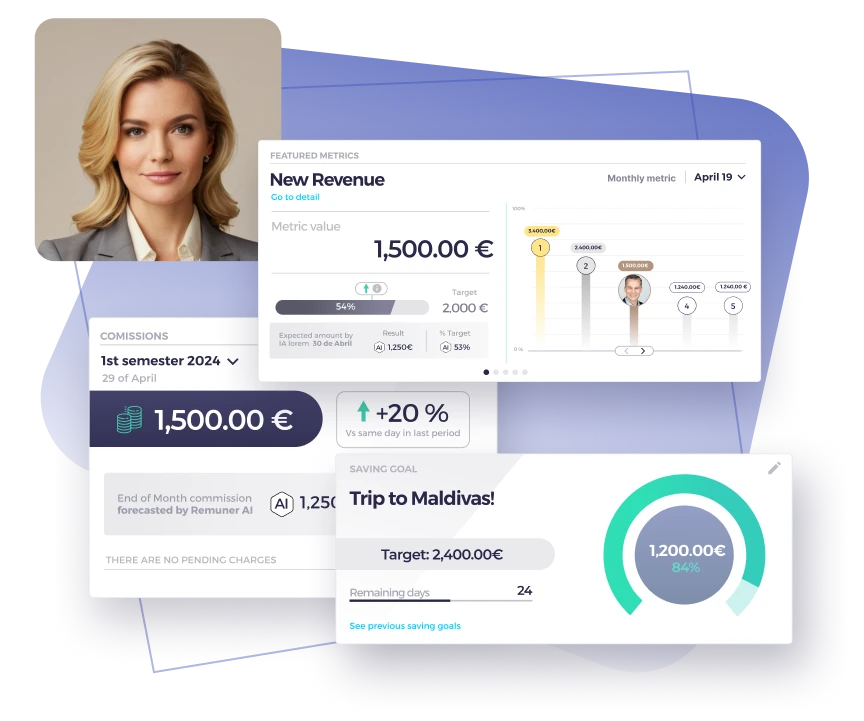
Managing a sales commission structure can quickly become complex, especially as your team grows and business objectives evolve. This is where Remuner comes in. Remuner’s platform simplifies the process by automating all aspects of your sales commission plans, from quota setting to payout calculations. Our system integrates effortlessly with your existing tools—CRMs, ERPs, and more—allowing you to create and manage any sales commission structure you need.
A great plan reps don’t trust performs like a bad one. Remuner puts any commission structure into practice: automated, CRM-connected calculations, a full audit trail for period close, and a with Remu AI you can give every rep real-time visibility into their earnings — without enterprise-grade complexity or cost. Book a demo now to see how Remuner can help you.