



💡 Quick Answer: Commission management software automates the full cycle of sales compensation — from calculation to payout — replacing error-prone spreadsheets with real-time, CRM-integrated automation. This guide reviews ten of the leading platforms on the market. Remuner leads the list with a 4.9/5 rating on G2, recognised for its AI-native plan builder, no-code flexibility, and real-time commission tracking.
Managing sales commissions in a spreadsheet costs revenue operations teams days of manual work every close cycle — and commission errors are consistently ranked among the top drivers of sales rep attrition. The right commission management software eliminates that overhead: calculations happen automatically as deals close, reps can see their earnings in real time, and admins stop spending their Mondays reconciling spreadsheet formulas.
This guide reviews the ten best commission management software tools in 2026 — covering what each one does well, where it falls short, and which type of team it actually fits.
What is commission management software?
Commission management software is a category of SaaS tools that automates the complete lifecycle of variable compensation: calculating commissions based on attainment and plan rules, tracking what’s owed per rep, reconciling disputes, and giving both reps and admins real-time visibility into earnings.
The category overlaps with incentive compensation management (ICM) software, a term traditionally used for enterprise-grade modeling platforms built for finance departments. Modern commission management software expands on that foundation: real-time CRM sync, no-code plan builders, and — increasingly — AI that can build comp plans, run scenario simulations, and answer rep questions without requiring an analyst.
How we evaluated these tools
We scored ten platforms across six criteria:
- Automation depth — can it handle splits, clawbacks, overrides, SPIFFs, and multi-tier hierarchies without custom engineering?
- AI capabilities — does the platform use AI to build plans, simulate changes, or answer rep questions?
- CRM integration quality — native vs. API-only; real-time sync vs. nightly batch.
- European readiness — GDPR compliance, EU data residency, multi-currency, local-language support.
- Time to go-live — days to first live calculation vs. weeks of professional services.
- Pricing model — per-seat, per-payee, or custom enterprise contract.
Commission management software: Quick comparison
| Tool | G2 Rating | Standout strength | Starting price |
|---|---|---|---|
| Remuner | ⭐ 4.9/5 | AI that builds plans, simulates payouts, and answers rep questions | On request |
| CaptivateIQ | 4.7/5 | SmartGrid formula engine for complex multi-tier logic | On request |
| Everstage | 4.8/5 | Best-in-class rep dashboards and gamification | On request |
| QuotaPath | 4.7/5 | Native HubSpot integration, fast self-serve setup | From ~$15/user/mo |
| Qobra | 4.8/5 | Fast no-code setup, EU-native compliance | On request |
| Salesforce Spiff | 4.6/5 | Native inside Salesforce CRM, zero extra integration | Bundled with Salesforce |
| Performio | 4.4/5 | Component-based builder for compliance-heavy orgs | On request |
| Xactly Incent | 4.2/5 | Enterprise scale, decades of ICM depth | On request |
| Varicent | 4.5/5 | BI-depth analytics, G2 Leader for High Performance | On request |
| Commissionly | — | Lightweight, fast setup for teams under 25 reps | From ~$30/user/mo |
G2 ratings sourced from G2.com; pricing from vendor websites — verify directly as both change.
The 10 best commission management software tools in 2026
1. Remuner
Remuner is one of the most capable and AI-native commission management platforms on the market, designed to handle comp plans of any complexity without engineering resources or lengthy implementations — whether you’re managing 50 reps or 5,000. Multi-tier accelerators, territory splits, clawbacks, SPIFFs, and multi-currency hierarchies all build through a no-code interface — and the platform handles them in real time, with calculations synced directly from your CRM. Most teams are up and running in days, not months.
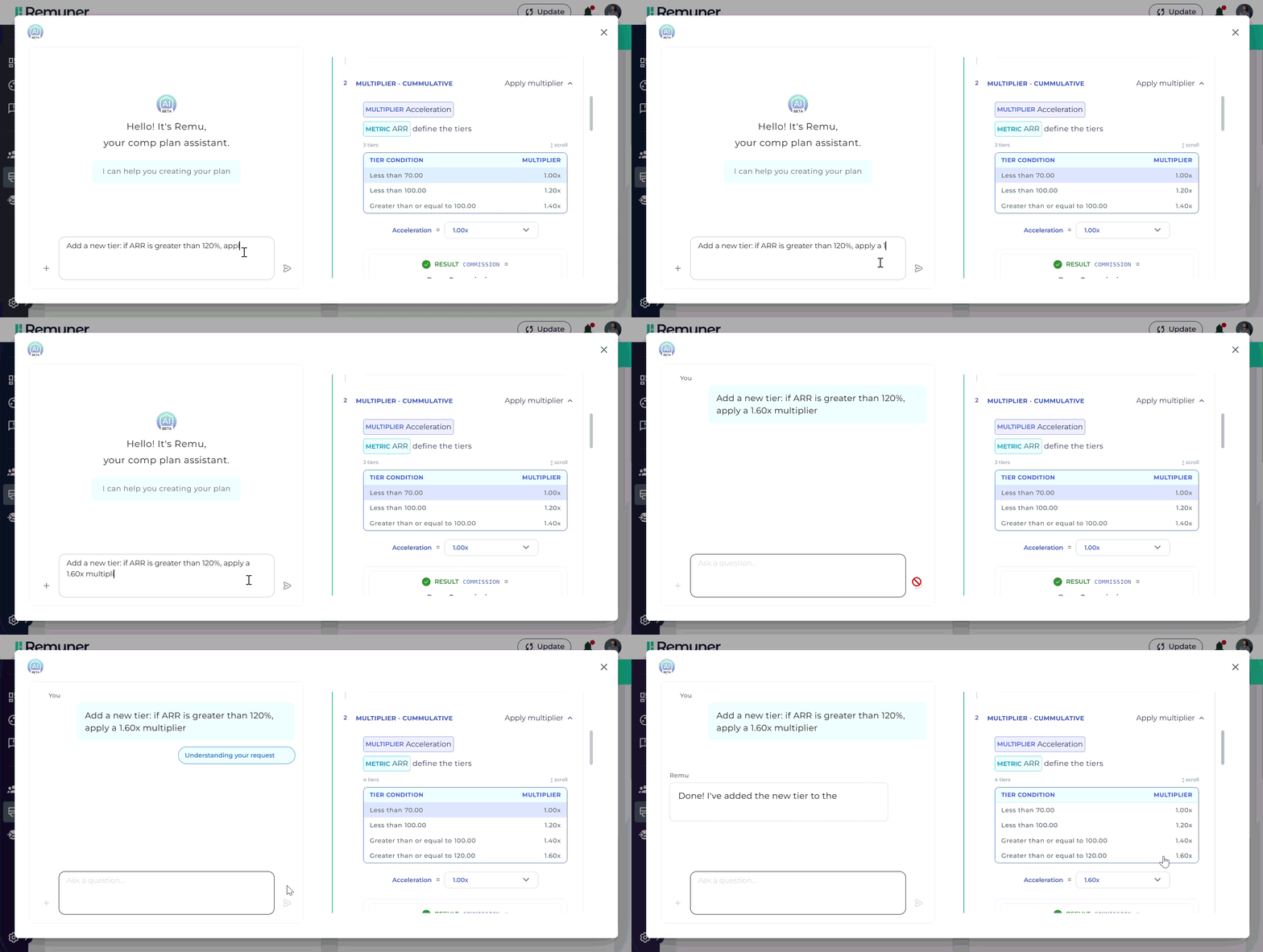
The real differentiator is Remu, Remuner’s AI compensation manager. Rather than manually configuring plan rules, you describe your business objectives and Remu builds the comp plan structure — then runs payout simulations before any change goes live and answers reps’ commission questions in natural language, cutting the back-and-forth that usually falls on finance and RevOps teams every month.
The premise is simple: money drives behaviour. Get the incentives right and your reps chase the goals that actually matter to the business. Commercial teams at Isdin, DKV, Alfasigma, and Philip Morris run their commission cycles on Remuner for exactly that reason.
Key features:
- No-code plan builder handling splits, tiers, accelerators, clawbacks, and SPIFFs
- Real-time commission calculations synced from Salesforce, HubSpot, and other CRMs
- Remu AI: plan creation, scenario simulation, and rep-facing commission Q&A
- Native multi-currency and multi-country plan management
- Audit trail and dispute management built in
- ISO 27001 certified; EU data residency
Best for: European mid-market and enterprise sales teams in pharma, insurance, telco, utilities, and retail/FMCG.
Pricing: On request — Book a demo at Remuner
2. CaptivateIQ
CaptivateIQ is one of the most configurable commission management platforms on the market, favored by enterprise sales operations teams managing complex, multi-tier plans. Its spreadsheet-like formula engine makes it accessible to RevOps analysts without requiring dedicated engineering resources.
The platform is strongest when deeply integrated with Salesforce, where it can pull granular opportunity data and calculate commissions at the line-item level. Onboarding is implementation-heavy: most teams take 6–12 weeks to fully configure CaptivateIQ for complex plan structures.
Best for: US and global enterprise teams with complex commission rules and dedicated RevOps headcount to manage ongoing configuration.
Limitations: Long implementation timelines; AI-native features lag newer platforms; enterprise-tier pricing.
3. Everstage
Everstage has earned a reputation for best-in-class rep-facing commission dashboards. Where most ICM tools are built for the admin’s benefit, Everstage explicitly designs for the rep: earnings projections, gamification elements, and strong mobile accessibility.
The platform handles mid-market plan complexity well and offers a solid analytics layer for managers. Integration breadth covers Salesforce, HubSpot, Zoho, and others.
Best for: Mid-market SaaS and technology companies that prioritize rep engagement and earnings transparency alongside automation.
4. QuotaPath
QuotaPath positions itself as commission management built for sales teams rather than finance departments. Its HubSpot integration is native and bidirectional, making it the default choice for HubSpot-centric RevOps stacks. Plan building is clean and accessible, though QuotaPath can struggle with highly complex split scenarios or deep multi-tier hierarchies at scale.
Best for: SMB to mid-market HubSpot users with straightforward commission structures and teams under ~200 payees.
5. Qobra
Qobra is a Paris-based commission management platform with a no-code plan builder, clean rep-facing dashboards, and solid CRM integrations. Built with European compliance in mind, it’s a credible alternative for mid-market teams that want an EU-native tool without the implementation overhead of larger enterprise platforms.
Best for: European mid-market companies looking for a no-code, EU-compliant commission management platform.
6. Salesforce Spiff
Salesforce Spiff (acquired by Salesforce in 2024) is now a native Salesforce product, accessible directly inside the CRM. For teams that are already Salesforce-first, Spiff eliminates the third-party integration overhead — data lives in one platform, permissions are inherited, and rollout is faster.
The trade-off: Spiff’s roadmap is now driven by Salesforce’s enterprise priorities, and teams not on Salesforce have little reason to consider it.
Best for: Salesforce-first enterprise and mid-market teams who want commission management inside their CRM without a third-party integration.
7. Performio
Performio is an Australian-headquartered commission management platform built for enterprise-level plan complexity: deep territory hierarchies, multi-currency, and custom calculation logic. It’s a common choice for large field sales organizations in pharma and medical devices.
Implementation requires professional services — this is not a self-serve tool. But for organizations managing commissions for 500+ payees with highly variable plan structures, Performio’s depth is difficult to match.
Best for: Enterprise teams in regulated industries with complex commission hierarchies.
8. Xactly Incent
Xactly is the legacy category-defining ICM platform. It has been the enterprise standard for over two decades, with deep integration into large-company finance stacks including SAP, Oracle, and Workday.
The trade-off is equally well-documented: Xactly is expensive, requires significant implementation investment, and its UI reflects its age. It remains the default for Fortune 500 companies with existing Xactly contracts and dedicated ICM program managers — less relevant for teams evaluating from scratch.
Best for: Large enterprises with existing Xactly relationships and complex finance-led comp programs.
9. Varicent
Varicent (formerly IBM Incentive Compensation Management) targets the largest enterprises with the most data-intensive compensation programs. Its analytics layer is particularly deep, useful for finance teams that need to model comp costs, run territory planning, and perform predictive analytics alongside commission management.
Like Xactly, Varicent is enterprise-only, requires significant services investment, and rarely fits mid-market needs.
Best for: Global enterprise companies with dedicated compensation analysts who need advanced modeling alongside commission tracking.
10. Commissionly
Commissionly is a lightweight commission management tool designed for small businesses and early-stage sales teams. Setup is fast, pricing is accessible, and the feature set covers the basics: plan creation, attainment tracking, and simple payout reporting. It doesn’t scale to enterprise plan complexity, but for teams under 25 reps on standard commission structures, it removes the spreadsheet burden without requiring an ICM project.
Best for: Small businesses and startups needing basic commission automation without enterprise pricing.
How to choose the right commission management software
Choosing between platforms comes down to four questions:
1. How complex are your plans? A single-rate commission structure for a small team will run fine on any tool here. Multi-tier accelerators, territory splits, SPIFFs, clawbacks, and 200+ payees require genuine depth — not a lightweight tool that hits its ceiling within six months.
2. What’s your CRM? Commission software is only as good as its data source. Prioritize native, real-time CRM sync. Nightly batch uploads leave reps with stale earnings numbers — exactly the kind of trust problem commission management is supposed to solve.
3. Where is your team based? If you operate in Europe, GDPR compliance and EU data residency are legal requirements, not optional settings. US-headquartered tools often treat EU compliance as a configuration task; EU-native platforms like Remuner and Qobra handle it by default.
4. Do you need AI, or just automation? Rules-based automation — calculate, track, pay out — is now table stakes. AI-native tools go further: building plans from scratch, simulating changes before rollout, and answering rep compensation questions without admin intervention. For lean RevOps teams, that compounds into significant time savings.
FAQs
What is commission management software?
Commission management software automates the calculation, tracking, and payout of variable compensation for sales teams. It replaces manual spreadsheet processes with rules-based automation, real-time CRM integration, and rep-facing dashboards that show earnings as they accrue.
What’s the difference between commission management software and ICM software?
Incentive compensation management (ICM) software traditionally refers to enterprise-grade platforms built for complex financial modeling and finance-department workflows. Commission management software is a broader category that includes ICM-style tools alongside lighter, more automation-focused platforms built for RevOps and sales operations teams. In practice, the terms are increasingly used interchangeably — though ICM typically implies greater plan complexity and finance ownership.
How much does commission management software cost?
Pricing varies widely. SMB tools like QuotaPath start at approximately $15–25 per user per month. Enterprise platforms — Xactly, CaptivateIQ, Varicent, Remuner — use custom pricing based on the number of payees and plan complexity, typically negotiated annually. Contact vendors directly for a current quote.
Which commission management software is best for European companies?
Remuner and Qobra are the two EU-native commission management platforms with built-in GDPR compliance, EU data residency, and local-language support. US-headquartered tools can be made GDPR-compliant through configuration, but EU-native platforms handle this by default — significantly reducing compliance overhead for European legal and IT teams. For a full breakdown of the European market, see our guide to sales compensation software in Europe.
Can commission management software integrate with Salesforce?
Yes — most platforms on this list offer Salesforce integration. The depth varies: Salesforce Spiff is now native inside Salesforce CRM. CaptivateIQ, Remuner, and Everstage offer deep API integrations with real-time sync. Lighter tools may rely on CSV imports or batched API calls, which introduce data latency and the commission trust issues that come with it.
How long does it take to implement commission management software?
Implementation timelines vary significantly by platform and plan complexity. Enterprise tools like Xactly and Varicent typically require 3–6 months of professional services. Mid-market platforms like CaptivateIQ average 6–12 weeks. AI-native platforms designed for faster deployment — like Remuner — can go live in days to weeks for straightforward plan structures.
The bottom line
The commission management software market has matured rapidly. The old model — months-long implementations, spreadsheet-adjacent interfaces, batch-updated data — is being displaced by AI-native platforms that deploy in days, simulate plan changes in real time, and answer reps’ compensation questions automatically.
For European sales teams, the choice is clear: prioritize EU-native tools that handle GDPR by default, support multi-currency operations, and are built for the commercial structures of your industry — not the US SaaS playbook.
Remuner leads that category, with Remu AI, real-time automation, and deep expertise across Commercial Excellence verticals including pharma, insurance, telco, and utilities. If your team has outgrown spreadsheets, book a demo to see it in practice.